What Hardware Do You Need to Start Flight Simming in the UK? Complete Checklist
Flight simulation has shifted dramatically in recent years. With Microsoft Flight Simulator and other quality sims now accessible on modest budgets, building a realistic home setup is genuinely achievable for UK enthusiasts. But the hardware choices can feel overwhelming if you're just starting out.
The good news: you don't need everything at once. A meaningful flight sim experience can begin with just a PC and a basic yoke-and-throttle combo. But understanding what each component does—and why it matters—helps you build a setup that actually keeps you engaged rather than gathering dust.
The Flight Controls: Where Your Money Goes
Your primary interface to the sim is the flight control hardware. This is where the hobby truly lives, and it's worth getting right from the start.
The Yoke or Joystick
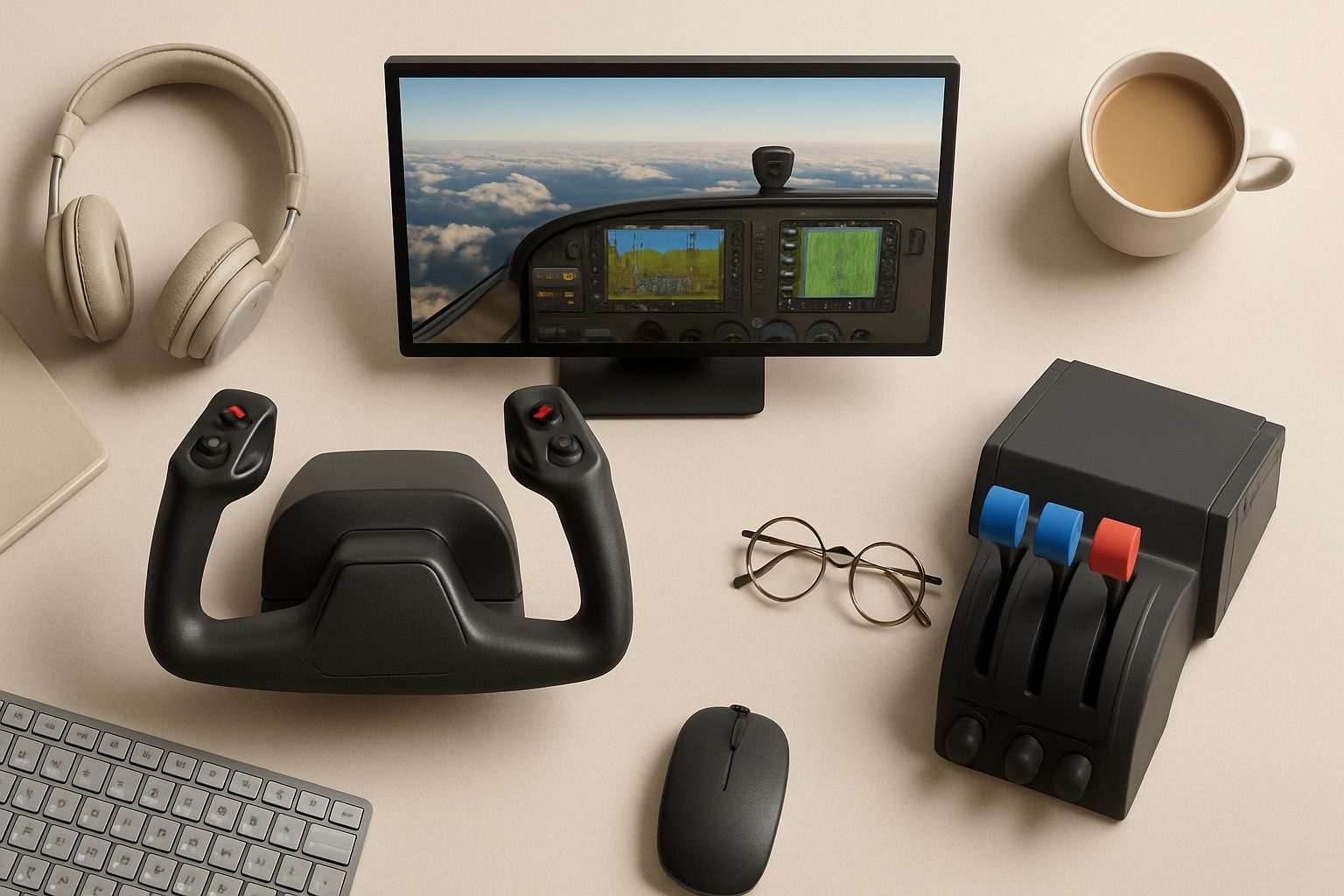
The yoke (or control stick, depending on aircraft type) is your primary control input. It's what moves the aircraft's pitch and roll. For most people new to flight simming, a yoke feels more intuitive than a stick—it mimics the control wheels in real commercial aircraft.
Entry-level yokes run from £100 to £250 and offer springs that centre the controls, making them forgiving for beginners. Mid-range options add button mapping flexibility and better build quality. If you're committing to the hobby seriously, this is worth investing in, as a poor yoke creates frustration that chips away at motivation. There are solid roundup articles on the site covering budget and mid-range yokes in detail.
Throttle Quadrant
The throttle isn't just a slider—it controls engine power, and in many aircraft, it's accompanied by propeller pitch and mixture controls. A basic throttle unit costs around £60–£150 and typically includes these three controls on a single panel.
What matters here is smooth resistance and positive detents. Cheap throttles sometimes feel mushy, which breaks immersion during landing. A quality throttle teaches you proper flight procedures because the controls demand respect rather than sloppy inputs.
Rudder Pedals
Rudders control the aircraft's yaw (nose direction during turns). This might sound optional, but it's not. Without rudder pedals, you're flying with one hand tied behind your back. You'll either map rudder to a twist grip on your yoke (which is awkward) or keyboard buttons (which is awful). Proper floor-mounted rudder pedals cost between £100 and £300, and they transform how the aircraft responds.
The investment here pays dividends immediately. Crosswind landings become manageable. Turns feel coordinated. Your flying actually improves because the hardware matches real-world input methods.
The Peripherals
Headset
A quality headset serves two purposes: it immerses you in the soundscape of flight (engine noise, radio chatter, wind), and it's essential if you're using voice-over-IP software like Vatsim to network with other pilots.
For flight simming, you don't need a gaming headset. In fact, aviation-specific headsets—designed to handle radio frequencies without distortion—are better. Expect to spend £80–£200 for something with active noise cancellation. Cheaper options exist, but audio quality directly affects immersion and your ability to hear radio calls clearly.
Monitor Setup
Most people start with a single monitor and find it perfectly adequate. But once you've experienced a dual or triple-monitor setup, single-screen feels constraining. Widescreen ultrawide monitors (around 34 inches) have become popular for flight sim, offering a wide field of view without needing multiple displays.
This is something you can upgrade into gradually. Don't feel pressured to buy multiple monitors immediately.
The PC: The Engine Room
Your PC needs to handle real-time 3D rendering, and it matters more than you'd expect.
Microsoft Flight Simulator is the current benchmark. Ultra settings demand a GPU like an RTX 4070 or equivalent, paired with a modern CPU (Intel 13th-gen or AMD Ryzen 7000-series) and at least 32GB RAM. You're looking at a total cost of £1,200–£2,000 for a capable system built from scratch.
That said, you can start on less powerful hardware. Medium settings on a GTX 1660 Super or RTX 3060 system still delivers a solid experience, especially on smaller regional flights. The key is frame rate stability—aim for at least 30fps consistently, though 60fps is genuinely noticeable and worth pursuing.
Worth noting: flight simulators are CPU-bound as much as GPU-bound. A fast SSD (NVMe) also makes a real difference during loading. Don't skimp here if you're building new.
Building Your First Setup
A realistic entry point looks like this: a basic yoke and throttle (£150–£200), rudder pedals (£120), a decent headset (£100), and either a new PC or an upgrade to an existing one (£800–£1,500). That's roughly £1,200–£2,000 to get genuinely airborne.
Alternatively, if you already have a reasonable PC, adding just the control hardware (£400–£500) gives you a complete experience that genuinely rivals what you'll find in many flight training centres.
The best setup is the one you'll actually use. Don't overbuy hoping it'll motivate you—start modest and expand once you've confirmed the hobby sticks. But do buy quality where it matters: controls and headset. These directly determine whether flying feels real or feels awkward.
More options
- Honeycomb Alpha Flight Controls Yoke (Amazon UK)
- Thrustmaster TCA Officer Pack Airbus Edition (Amazon UK)
- Logitech G Pro Flight Rudder Pedals (Amazon UK)
- Meta Quest 3 VR Headset (Amazon UK)
- Honeycomb Bravo Throttle Quadrant (Amazon UK)