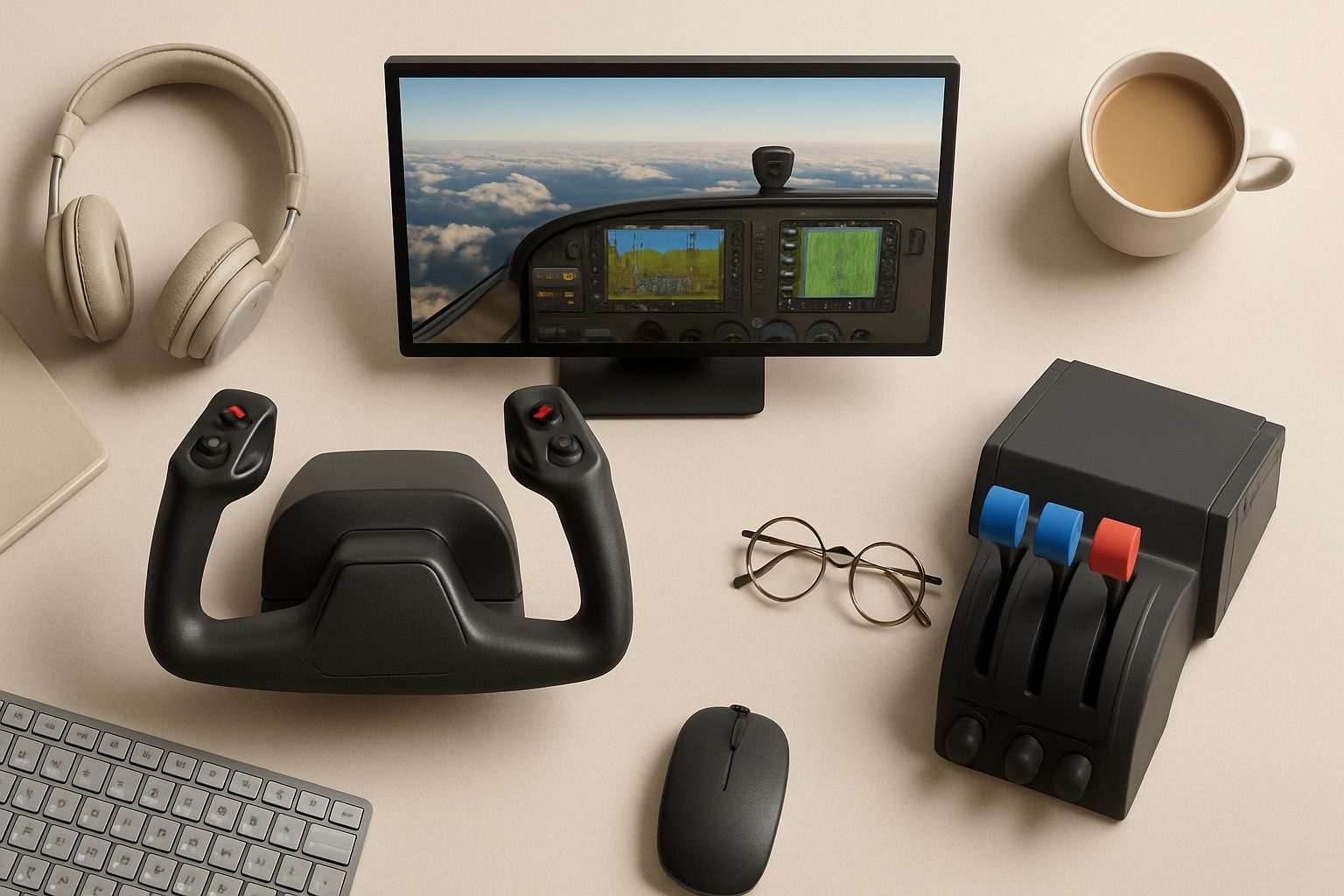
Thrustmaster TCA vs Honeycomb Bravo Throttle Quadrant: Full UK Review 2025
If you're serious about home flight simulation in the UK, your throttle control matters as much as your yoke. The Thrustmaster TCA (Airbus Edition) and Honeycomb Bravo are the two throttles most people actually buy, yet they approach the problem completely differently. This review covers which suits your setup, your aircraft choice, and your budget.
The Core Difference: Airbus vs Generic
The Thrustmaster TCA is purpose-built for Airbus aircraft. It mimics the actual Electronic Flight Instrument System (EFIS) layout with a side-stick compatibility mode and duplicates Airbus throttle behaviour: detents at idle, approach, and climb, with a reverse-thrust gate. It feels like walking into an A320 cockpit.
The Honeycomb Bravo is hardware-agnostic. It's a traditional throttle quadrant with four identical axes that you map however you like. It works brilliantly for Boeing, regional aircraft, and vintage warbirds, but it lacks Airbus-specific logic. If you fly primarily Cessnas or B737s, Bravo is your thing. If you're buying this specifically for MSFS 2024 Airbus releases, TCA wins on authenticity alone.
Axis Count and Functionality
The TCA delivers three axes: two thrust levers and a dedicated reverse-thrust axis that only engages past a physical gate. Airbus pilots immediately recognise this. There's also a tiller (nosewheel steering) that integrates cleanly into the Airbus workflow. No need to rebind anything—it just works as Airbus designed it.
The Bravo packs four independent throttle axes, plus separate controls for propeller pitch, mixture, and trim. That sounds more flexible, but flexibility matters only if you need it. For serious Airbus flying, the TCA's purposeful limitation is actually an advantage. You're not hunting through mappings; you're learning muscle memory that transfers to real Airbus procedures.
Build Quality and Durability
Both are built to last, though they take different approaches. The TCA feels like aircraft hardware: machined aluminium, satisfying clicks on the detents, a solid base. The reverse-thrust gate has a spring-loaded mechanism that requires deliberate engagement—you won't accidentally activate it during approach. It's robust but not as compact; it sprawls across your desk.
The Honeycomb Bravo is smaller and more densely packed. The switches and levers feel quality, but the overall assembly is lighter. Honeycomb's support is excellent; they release firmware updates regularly that add features and refine axis behaviour. TCA updates are less frequent, partly because there's less to improve on a purpose-built system.
Both will last years of regular use. Neither is cheap enough to treat as disposable, but both are reliable enough that you won't be anxious every time you take off.
MSFS 2024 Compatibility
This is where decisions get practical. MSFS 2024 ships with official Airbus aircraft (A320 and A380 variants from Asobo). The TCA works flawlessly with these—Thrustmaster and Microsoft have clearly coordinated. The detents align, the reverse thrust behaves correctly, and the tiller integrates. You unbox it and fly.
The Bravo works with MSFS 2024, but it requires manual mapping. You'll configure the four axes as left engine throttle, right engine throttle, prop pitch, and reverse thrust (using a modifier). It works, but it's an extra 20 minutes of setup, and some users report that reverse-thrust behaviour feels slightly less intuitive because the Bravo has no physical gate to make the action feel distinct.
For Boeing aircraft or third-party Airbus add-ons (like Fenix or PMDG), the difference narrows. Both map effectively, though Bravo's multiple axes give you more control options for complex aircraft.
Price and UK Availability
The TCA retails around £400–£450 in the UK, sometimes discounted to £350 during sales. It's a significant investment, but it's a complete Airbus solution. You don't need additional pedals or trim controllers—the TCA provides everything.
The Bravo sits around £280–£320 in the UK. It's cheaper, but then you often add rudder pedals, a trim wheel, and possibly a mixture lever if you fly general aviation. Stack those costs, and you're approaching TCA pricing anyway, except you've bought separate items that don't form a cohesive system.
Both are available from UK retailers, though TCA stock can be sporadic. Expect 2–4 week lead times if you're unlucky.
Who Should Buy Which
Get the TCA if: You're committed to Airbus aircraft, you value authenticity and immersion, you don't mind the larger footprint, and you want plug-and-play MSFS 2024 compatibility. It's the best choice for serious Airbus training or entertainment flying.
Get the Bravo if: You fly mixed fleets (Airbus and Boeing), you prefer a compact layout, you like the flexibility to reconfigure for different aircraft, or you enjoy tinkering with settings. It's also the better choice if you own older sims or external add-on aircraft packages.
The Verdict
Neither is wrong. Both deliver satisfying, realistic throttle control that will transform your flying. The TCA is the specialist tool—it excels at one thing and does it superbly. The Bravo is the generalist—it handles anything you throw at it, though without Airbus-specific finesse.
If you're buying today for MSFS 2024 and you've been eyeing the Asobo Airbus fleet, the TCA edges ahead on value. You'll spend more upfront but less time troubleshooting configuration. For everyone else, Honeycomb's flexibility and lower entry price make it the sensible choice.
Both will serve you well for years. Choose based on the aircraft you love, not the one you think you should buy.
More options
- Honeycomb Alpha Flight Controls Yoke (Amazon UK)
- Thrustmaster TCA Officer Pack Airbus Edition (Amazon UK)
- Logitech G Pro Flight Rudder Pedals (Amazon UK)
- Meta Quest 3 VR Headset (Amazon UK)
- Honeycomb Bravo Throttle Quadrant (Amazon UK)