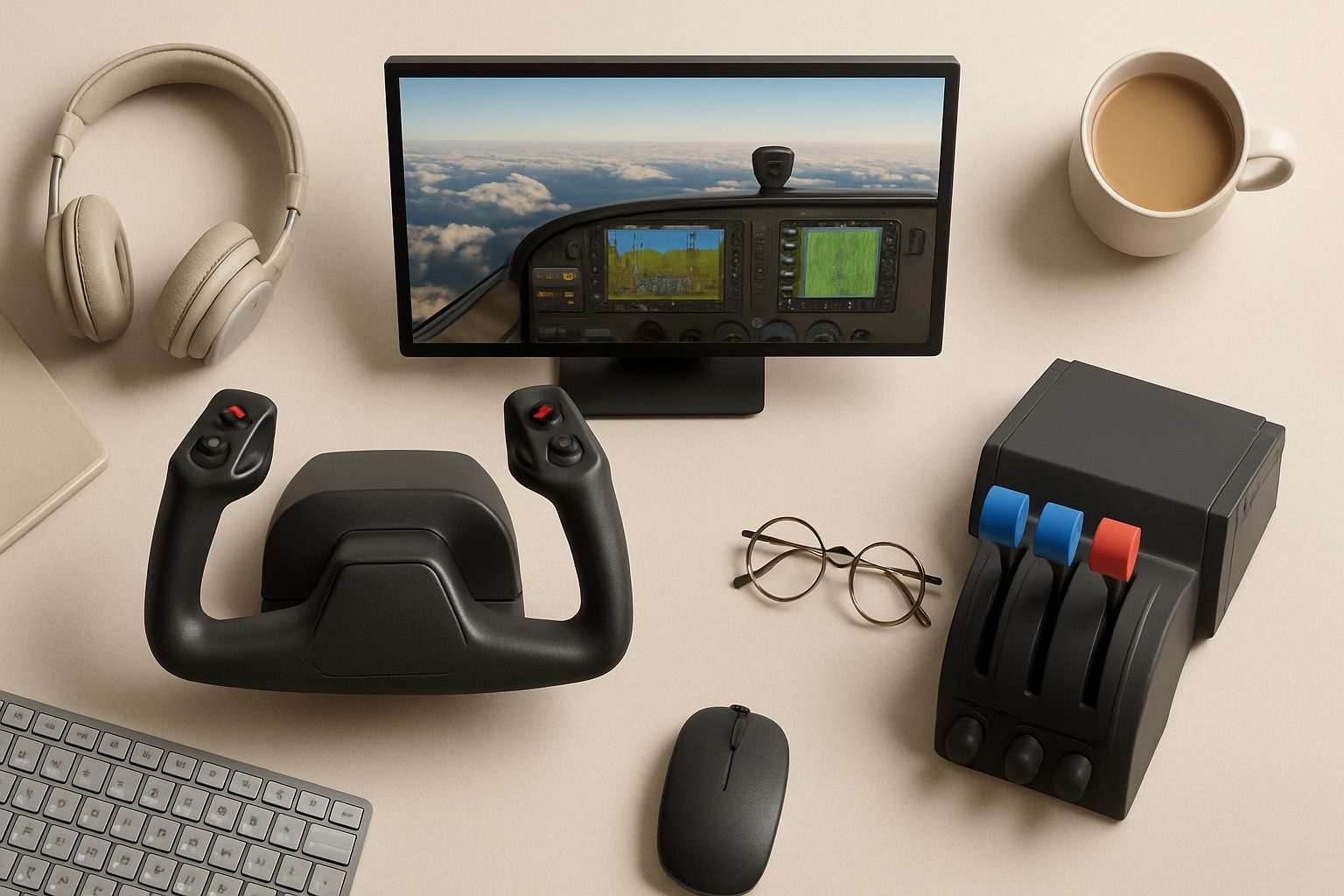
MSFS 2024 vs X-Plane 12: Which Flight Sim Software Is Best for UK Pilots?
If you're building a home flight simulator in the UK, the software choice sets the tone for everything else: your hardware budget, the visual experience, and how well it trains your skills for real flying. Microsoft Flight Simulator 2024 and X-Plane 12 are the two serious contenders, and they take fundamentally different approaches. Understanding those differences matters before you commit to one platform.
The Core Philosophy
Microsoft Flight Simulator 2024 is a visual-first simulator built on Azure cloud integration and photogrammetric scenery. It prioritises stunning visuals and accessibility, making it appealing to simmers who want the world to look real. X-Plane 12, by contrast, is built by actual pilots and aeronautical engineers at Laminar Research. It prioritises physics fidelity and has been the industry standard for serious training and professional use for decades.
This split affects everything downstream—not just how the planes look, but how they behave, what they demand from your hardware, and what kind of flying you'll actually be practising.
Flight Physics: Where It Matters
X-Plane 12's flight model is genuinely more sophisticated. It models aerodynamic forces on individual control surfaces and calculates lift, drag, and thrust in three dimensions at every frame. The feel of flying is more honest: a stall in X-Plane happens where it would in a real aircraft, with recognisable warning signs.
MSFS 2024 has improved significantly here—the flight model is now substantially better than MSFS 2020—but it still simplifies some aerodynamic calculations to keep performance manageable across different hardware tiers. Many pilots describe MSFS as feeling slightly more forgiving, which can be good for beginners but less useful if you're trying to build habits that transfer to real flying.
For UK-based pilots pursuing their PPL, the difference is tangible. X-Plane's behaviour in slow-flight, crosswind landings, and unusual attitudes maps more closely to what you'll encounter during actual training flights.
UK Scenery: It's Complicated
MSFS 2024's photogrammetric coverage is more impressive in sheer visual quality. If you fly over London, Edinburgh, or Manchester, the cities look photorealistic. Runways are accurately modelled, and major airports have high-detail custom scenery. It's genuinely beautiful.
X-Plane 12's default UK scenery is procedurally generated rather than photogrammetric. Terrain is accurate, airports are correctly positioned, but cities look more generic. The upside: add-on scenery for X-Plane tends to be cheaper and easier to install. If you want hyper-detailed versions of specific airfields—say, Prestwick or Shobdon—X-Plane's add-on ecosystem is robust.
If visual immersion drives you, MSFS wins. If you plan to fly hundreds of hours around a specific region and want pinpoint accuracy, X-Plane's add-on approach often offers better value.
Hardware Demands
This is where the philosophies diverge sharply. MSFS 2024 scales better across hardware tiers, but high-end performance requires serious investment. Running it smoothly at high settings—especially with photogrammetry enabled—demands a modern GPU (RTX 4070 or better) and plenty of VRAM. Flying at Ultra settings in complex airports will tax even high-end rigs.
X-Plane 12 is more CPU-dependent and generally lighter on GPU resources. It'll run acceptably on mid-range hardware, though you'll want a good CPU and reasonable GPU. It's more predictable: upgrading your processor gives more tangible gains than in MSFS.
For UK simmers on a budget, X-Plane 12 is the more forgiving choice. If you already have a gaming PC built within the last two years, you'll likely have a smoother experience with X-Plane at decent settings.
Training and PPL Preparation
This is where X-Plane's reputation matters most. It's used in professional flight schools and by serious bush pilots training for backcountry operations. The accuracy of its systems modelling—engine temperatures, electrical systems, fuel management—is exceptionally good.
MSFS 2024 has closed the gap, and many modern training devices now use MSFS as a platform. However, if your goal is to prepare for actual PPL training, X-Plane's flight model and systems depth make it a more direct analogue to what you'll learn in a real aircraft.
That said, both platforms can teach you the fundamentals effectively. The difference matters most for advanced skills—crosswind landings, slow-flight, system management—where X-Plane's fidelity gives you better preparation.
Add-ons and Ecosystem
X-Plane has a mature, robust add-on ecosystem. Aircraft tend to be highly detailed and affordable (£20–50). Scenery add-ons cover UK airfields comprehensively. The community is active and welcoming.
MSFS has a growing ecosystem, but it's smaller and add-ons tend to be pricier. Microsoft's own marketplace quality varies. For pure content volume, X-Plane wins.
Which Should You Choose?
Choose MSFS 2024 if you prioritise visual immersion, want photorealistic scenery of the UK, and have modern gaming hardware. It's also the more accessible entry point for casual simmers.
Choose X-Plane 12 if you're serious about training, want better value on a mid-range budget, and prefer honest flight physics that transfer to real flying. It's the more predictable platform for long-term commitment.
Both are excellent simulators. Your choice hinges on whether visual spectacle or flight fidelity matters more to your flying goals.
More options
- Honeycomb Alpha Flight Controls Yoke (Amazon UK)
- Thrustmaster TCA Officer Pack Airbus Edition (Amazon UK)
- Logitech G Pro Flight Rudder Pedals (Amazon UK)
- Meta Quest 3 VR Headset (Amazon UK)
- Honeycomb Bravo Throttle Quadrant (Amazon UK)