Honeycomb Alpha vs Logitech G Pro Flight Yoke: Which Should UK Simmers Buy?
If you're building a serious home flight simulator setup in the UK, the question of which yoke to buy sits right at the centre of your decision. The Honeycomb Alpha and Logitech G Pro Flight Yoke are the two hardware darlings of the sim community right now—both deliver genuine cockpit feel, both integrate cleanly with MSFS 2024, and both cost enough that you'll want to choose wisely. Here's what separates them.
Build quality and ergonomics
The Honeycomb Alpha feels like it was designed by people who actually spend time in aircraft. The yoke is heavier, more substantial, and tracks closer to the real thing—you get that satisfying resistance, with smooth centering forces that don't feel digital or twitchy. The grip is textured plastic, the throw is proportional, and the overall assembly quality is genuinely excellent. British simmers who've demoed it often say: "This feels like a proper control surface."
The Logitech G Pro Flight Yoke prioritises a different philosophy: it's lighter, more arcade-friendly, and more compact. That's not a weakness—it's a choice. If your setup runs on a narrow desk or you're transitioning from controller flying, the Logitech's smaller footprint and easier throw matter. The build is solid, though it feels lighter in hand and the resistance is noticeably gentler than the Honeycomb.
For raw ergonomic authenticity, the Honeycomb wins. For practical living-room simulation, it's closer than you'd think.
Buttons, switches, and integration
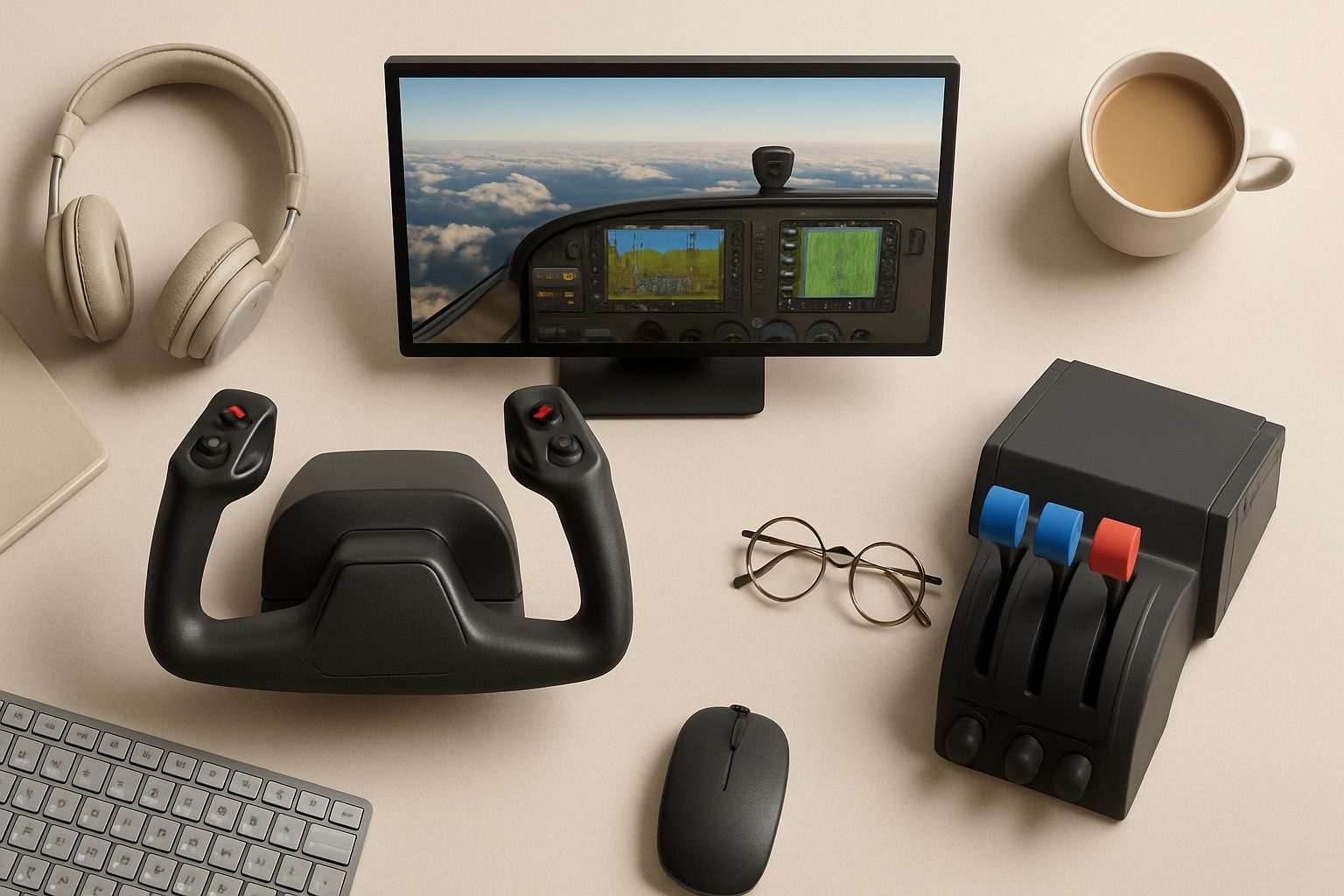
Here's where the comparison gets granular. The Honeycomb Alpha ships with a standalone throttle quadrant—separate unit, physical levers for throttle, prop pitch, and mixture, plus landing gear and flaps switches. You're buying two boxes. That's extra desk real estate, but the throttle levers are tactile and satisfying. If you've flown GA, this feels right.
The Logitech G Pro Flight Yoke bundles throttle control directly into the yoke via two side-mounted levers. Simpler, more compact, fewer cables. The buttons and switches integrate neatly into the yoke itself. Less authentic to a 172, but more practical for a flat-packed sim cockpit.
For button mapping: the Honeycomb uses proprietary software (Windows-only), which works well but requires setup. Logitech leverages its broader ecosystem—drivers are robust, and many UK simmers report zero configuration headache. Both work flawlessly in MSFS, but Logitech's plug-and-play reputation holds up in practice.
Precision and flight dynamics
Stick with me here, because this is where real experience matters. The Honeycomb Alpha's throw and centering force produce tighter, more precise pitch and roll control. In approaches and instrument flying, you'll notice the difference—especially on cross-wind landings where tiny inputs matter. The dual-pivot design feels stable and responsive without being oversensitive.
The Logitech G Pro Flight Yoke is fully capable and accurate enough for VFR and casual IFR. But if you're logging hours in payware aircraft or serious training scenarios, the Honeycomb's mechanical refinement pulls ahead. It's not that Logitech is imprecise; it's that Honeycomb gets that last 5% closer to actual aircraft handling.
For bush flying and tail-dragger circuits, many simmers report the Honeycomb's feel translates better. The Logitech is fine—genuinely fine—but less forgiving of sloppy technique.
Price and value
Here's the reality: the Honeycomb Alpha (yoke + throttle) costs roughly £400–450 in the UK market. The Logitech G Pro Flight Yoke alone comes in closer to £200–250. That's a significant gap.
If you're comparing pound-for-pound, the Logitech is undeniably better value for casual flying. You're getting a credible, well-integrated yoke at half the cost. But "cheaper" doesn't always translate to "better value"—spend another £150-200 and you're onto genuine professional-grade feel.
The Honeycomb holds resale value better, too. British simmers upgrading to full cockpits often buy used Honeycomb gear because the supply is tighter and reputation is strong.
Verdict: Who should buy which?
Beginner VFR pilots and casual flyers: Logitech G Pro Flight Yoke. You save money, the setup is simpler, and the learning curve is gentler. The yoke is accurate enough for navigation and cruise flying. Spend the difference on scenery or payware aircraft.
Intermediate and serious simmers: Honeycomb Alpha. If you're chasing realistic approach procedures, tailoring trim inputs, or flying complex aircraft, the mechanical feel and precision justify the cost. It's the choice of simmers who've already invested in good headtracking or VR, and who treat MSFS like actual training.
Space-constrained setups: Logitech. The integrated throttle and smaller footprint win. You won't miss what you don't have to buy separately.
Long-term cockpit builders: Honeycomb. It's the foundation of pro-grade home sims. It scales well with future upgrades (pedals, throttle quadrant expansion, trim wheel) and the community support is deeper.
Both yokes will deliver rewarding home simming. The Honeycomb is the better stick. The Logitech is the smarter first purchase for most. Choose based on your ambition, not the price tag alone.
More options
- Honeycomb Alpha Flight Controls Yoke (Amazon UK)
- Thrustmaster TCA Officer Pack Airbus Edition (Amazon UK)
- Logitech G Pro Flight Rudder Pedals (Amazon UK)
- Meta Quest 3 VR Headset (Amazon UK)
- Honeycomb Bravo Throttle Quadrant (Amazon UK)